
Every manufacturer has one person who quietly makes the judgment calls that no system, no process, and no other team member can handle. Here are the six decisions that prove it.
You have someone on your team right now, probably not the most senior person or the most visible, who everyone routes through when something doesn’t fit the standard process. When a request is unclear, the system gives a wrong answer, or a customer needs something that falls outside the normal workflow, your team contacts this person. You know exactly who it is.
Your operation is not running on your company’s heavily invested internal systems. It is running on what that person knows, what they remember, and the judgment they have built over years of doing the work. None of that lives in any system you own.
The six decisions below will tell you whether that describes your team.
Identifying the Right Part from a Vague Request
A customer sends your team a request that says something like “I need the part on the left side of the machine.” Your system returns nothing useful. The request does not contain a valid part number, a model reference, or enough detail to narrow it down.
But an experienced person knows exactly which machine generation that customer is running, which two parts always get confused in that configuration, and what follow-up question to ask to confirm. Nobody else on your team can answer this with confidence.
Your system stores data. Your experienced person interprets what the customer actually means. Without that person, the data does not translate into a correct answer.
Overriding the System When the Data Is Wrong
Your ERP says the part is in stock. Your PLM says it is compatible. Your pricing tool says the margin is acceptable. Everything looks correct on paper.
But your experienced person knows when the data is stale, when the catalog has an error that nobody has corrected, and when “compatible” on paper does not mean compatible in the customer’s specific configuration. They override the system. They do not always explain why, and nobody documents the reason.
System confidence and operational accuracy are not the same thing. Your experienced person knows the difference. Your systems do not.
Cross-Referencing a Competitor’s Part to Yours
A customer calls and asks for a competitor’s part number. Your catalog shows no direct match.
An experienced person knows which of your parts is functionally equivalent. Not from a cross-reference table, but from years of working with these products, from a conversation with engineering that happened a long time ago, or from a return that revealed the answer. Most of your other reps tell the customer, “We do not carry that,” and end the call.
Every time your experienced person is unavailable, that replacement sale does not happen. The customer gets what they need from someone else.
What These First Three Decisions Have in Common
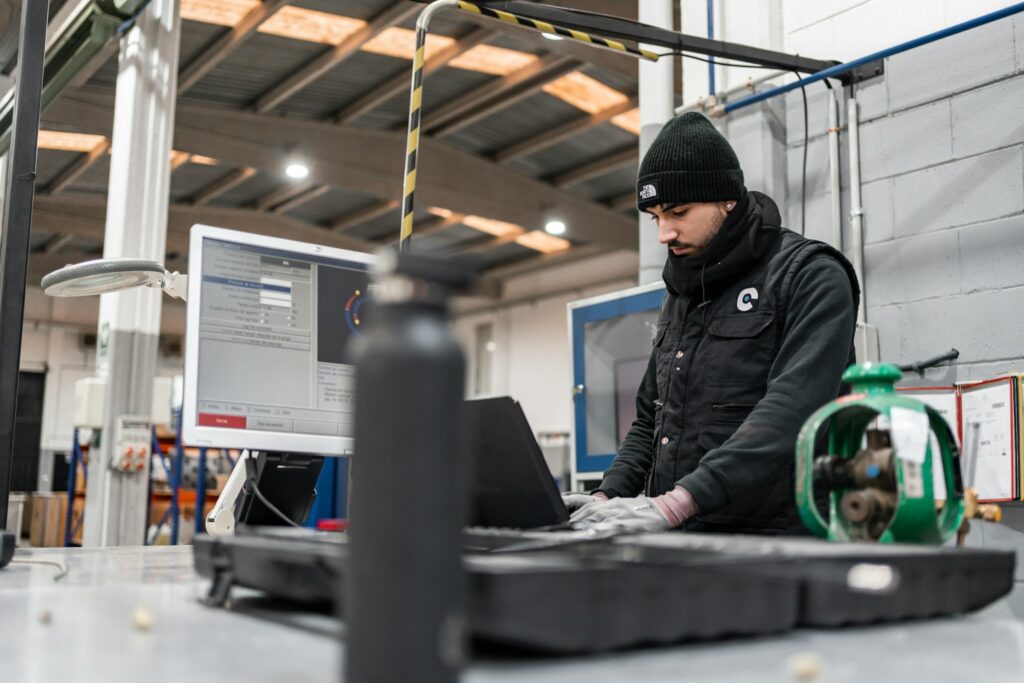
None of these first three decisions live in your ERP, your PLM, or any system you have purchased or built. All three live inside the head of one person on your team. Your business depends on what that person knows, and none of it is written down anywhere.
Approving a Warranty Claim, the Policy Says to Deny
Your policy says to deny it. The situation says to approve it.
Your experienced person knows which customers should get the benefit of the doubt, which claims will cost more to fight than to honor, and which distributor relationships are worth protecting even when the paperwork is incomplete. The rest of your team either escalates to that person or makes inconsistent decisions on their own.
Inconsistent claim decisions do not stay internal. Your distributors compare notes, and the inconsistency becomes a relationship problem.
Holding a Quote That Looks Ready but is Not
The quote checks out. Specifications match, margin is acceptable, and the line items are complete.
But your experienced person spots something the rest of your team would miss. A configuration that has caused problems before, a customer who always comes back with changes, or a line item that looks standard but never is. They flag the quote before it goes out. Without them, your team sends it and deals with the consequences later.
The cost of a bad quote is not just the margin adjustment. It is the rework, the delayed project, and the erosion of your customer’s confidence in your team.

Choosing Between Parts That Look The Same but Perform Differently
Three parts with the same dimensions, the same catalog category, and the same price range. But completely different torque tolerances.
A wrong part shipped is not always a picking error. Sometimes it is a knowledge error, and those are far more expensive to correct.
Your experienced person is not removed from the process. Their job just got a whole lot easier, and the rest of your team is no longer stuck waiting on them.
An experienced person knows which part is correct for this specific application. They learned it from a return three years ago, from a customer complaint that never made it into any system, or from a note in a spreadsheet that nobody else has access to.
The Risk Underneath All Six Bottlenecks
None of these decisions is documented in any system your company owns. They were built up over years of experience, stored inside one person’s head, and invisible to everyone else on your team.
That person will take a vacation. They will get pulled into a project for two weeks. They will eventually retire or move on. Each of those moments costs your operation speed, accuracy, and customer trust that you cannot recover after the fact.
What the Manufacturers Who Fixed This Actually Did
They did not try to replace that person, and they did not try to document everything into a knowledge base that nobody would use.
This is not a one-time risk. It is a pattern that repeats every time demand spikes, every time you onboard a new hire, and every time two requests arrive at the same time and only one of them gets your expert. This problem does not improve with time. It becomes more expensive.
What stays the same in every case is that your most experienced person is still the final authority. The AI does not make decisions on its own. It does the research, pulls the context, and presents a recommendation. Your best person reviews it and approves it. The difference is that instead of doing all of that work from scratch every single time, they are reviewing an answer that is already 90 percent of the way there. The work that used to take 20 minutes takes 2. The decisions that used to wait in a queue until that person was free now move forward immediately.
They worked with a team that looked at each decision individually. What is the context around it, what systems are already in place, and what outcome does the business actually need. In some cases the answer was automation. In others, it was a digital assistant that works alongside the team. In others it was a hybrid where AI handles the routine judgment and a person steps in for the edge cases.
Want us to Map Your Decisions?
We will map the specific decisions in your operation that currently sit with one or two people and show you which of those decisions AI can handle today, which ones require a hybrid approach, and which ones still need a person.
30 minutes. You keep the map whether or not we work together.